
Your Personality Analysis
Your personality in the five domains of the Big Five model
66abc3afd0be6c000823cb6501/08/2024Agreeableness
Agreeableness reflects individual differences in concern with cooperation and social harmony. Agreeable individuals value getting along with others.
Conscientiousness
Conscientiousness concerns the way in which we control, regulate, and direct our impulses.
Openness To Experience
Openness to Experience describes a dimension of cognitive style that distinguishes imaginative, creative people from down-to-earth, conventional people.
Neuroticism
Neuroticism refers to the tendency to experience negative feelings.
Neuroticism
Neuroticism refers to the tendency to experience negative feelings.
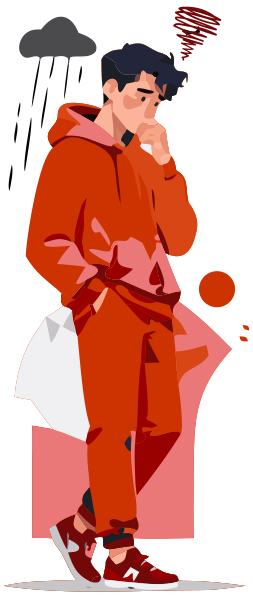
Your score on Neuroticism is high, indicating that you are easily upset, even by what most people consider the normal demands of living. People consider you to be sensitive and emotional.
Those who score high on Neuroticism may experience primarily one specific negative feeling such as anxiety, anger, or depression, but are likely to experience several of these emotions.
People high in neuroticism are emotionally reactive. They respond emotionally to events that would not affect most people, and their reactions tend to be more intense than normal. They are more likely to interpret ordinary situations as threatening, and minor frustrations as hopelessly difficult.
Their negative emotional reactions tend to persist for unusually long periods of time, which means they are often in a bad mood. These problems in emotional regulation can diminish a neurotic's ability to think clearly, make decisions, and cope effectively with stress.
Extraversion
Extraversion is marked by pronounced engagement with the external world.

Your score on Extraversion is high, indicating you are sociable, outgoing, energetic, and lively. You prefer to be around people much of the time.
Introverts lack the exuberance, energy, and activity levels of extraverts. They tend to be quiet, low-key, deliberate, and disengaged from the social world. Their lack of social involvement should not be interpreted as shyness or depression; the introvert simply needs less stimulation than an extravert and prefers to be alone.
The independence and reserve of the introvert is sometimes mistaken as unfriendliness or arrogance. In reality, an introvert who scores high on the agreeableness dimension will not seek others out but will be quite pleasant when approached.
Agreeableness
Agreeableness reflects individual differences in concern with cooperation and social harmony. Agreeable individuals value getting along with others.

Your high level of Agreeableness indicates a strong interest in others' needs and well-being. You are pleasant, sympathetic, and cooperative.
Disagreeable individuals place self-interest above getting along with others. They are generally unconcerned with others' well-being, and therefore are unlikely to extend themselves for other people. Sometimes their skepticism about others' motives causes them to be suspicious, unfriendly, and uncooperative.
Agreeableness is obviously advantageous for attaining and maintaining popularity. Agreeable people are better liked than disagreeable people. On the other hand, agreeableness is not useful in situations that require tough or absolute objective decisions. Disagreeable people can make excellent scientists, critics, or soldiers.
Openness To Experience
Openness to Experience describes a dimension of cognitive style that distinguishes imaginative, creative people from down-to-earth, conventional people.

Your score on Openness to Experience is high, indicating you enjoy novelty, variety, and change. You are curious, imaginative, and creative.
Nonetheless, Intellect is probably best regarded as one aspect of openness to experience. Scores on Openness to Experience are only modestly related to years of education and scores on standard intelligent tests.
Another characteristic of the open cognitive style is a facility for thinking in symbols and abstractions far removed from concrete experience. Depending on the individual's specific intellectual abilities, this symbolic cognition may take the form of mathematical, logical, or geometric thinking, artistic and metaphorical use of language, music composition or performance, or one of the many visual or performing arts.
People with low scores on openness to experience tend to have narrow, common interests. They prefer the plain, straightforward, and obvious over the complex, ambiguous, and subtle. They may regard the arts and sciences with suspicion, regarding these endeavors as abstruse or of no practical use. Closed people prefer familiarity over novelty; they are conservative and resistant to change.
Openness is often presented as healthier or more mature by psychologists, who are often themselves open to experience. However, open and closed styles of thinking are useful in different environments. The intellectual style of the open person may serve a professor well, but research has shown that closed thinking is related to superior job performance in police work, sales, and a number of service occupations.
Conscientiousness
Conscientiousness concerns the way in which we control, regulate, and direct our impulses.

Your score on Conscientiousness is high. This means you set clear goals and pursue them with determination. People regard you as reliable and hard-working.
Nonetheless, acting on impulse can lead to trouble in a number of ways. Some impulses are antisocial. Uncontrolled antisocial acts not only harm other members of society, but also can result in retribution toward the perpetrator of such impulsive acts. Another problem with impulsive acts is that they often produce immediate rewards but undesirable, long-term consequences. Examples include excessive socializing that leads to being fired from one's job, hurling an insult that causes the breakup of an important relationship, or using pleasure-inducing drugs that eventually destroy one's health.
Impulsive behavior, even when not seriously destructive, diminishes a person's effectiveness in significant ways. Acting impulsively disallows contemplating alternative courses of action, some of which would have been wiser than the impulsive choice. Impulsivity also sidetracks people during projects that require organized sequences of steps or stages. Accomplishments of an impulsive person are therefore small, scattered, and inconsistent.
A hallmark of intelligence, what potentially separates human beings from earlier life forms, is the ability to think about future consequences before acting on an impulse. Intelligent activity involves contemplation of long-range goals, organizing and planning routes to these goals, and persisting toward one's goals in the face of short-lived impulses to the contrary. The idea that intelligence involves impulse control is nicely captured by the term prudence, an alternative label for the Conscientiousness domain. Prudent means both wise and cautious.
Persons who score high on the Conscientiousness scale are, in fact, perceived by others as intelligent. The benefits of high conscientiousness are obvious. Conscientious individuals avoid trouble and achieve high levels of success through purposeful planning and persistence. They are also positively regarded by others as intelligent and reliable. On the negative side, they can be compulsive perfectionists and workaholics. Furthermore, extremely conscientious individuals might be regarded as stuffy and boring.
Unconscientious people may be criticized for their unreliability, lack of ambition, and failure to stay within the lines, but they will experience many short-lived pleasures and they will never be called stuffy.
Assertiveness
Takes charge when direction is lacking.

Excitement-Seeking
May be perceived as unadventurous or overly cautious.
Unlock your AI Companion and growth tools
Use your Big Five result with AI Companion, track your growth over time, and compare your profile with another person. Your result is saved so you can return anytime.
Inside My Profile you can compare this saved profile with another result ID, reopen Companion, and keep working from one private home.
Open My ProfileLatest winner: Ticket #35D8 | Banī Suwayf, Egypt
Win a Core report. One winner daily. No purchase required.