

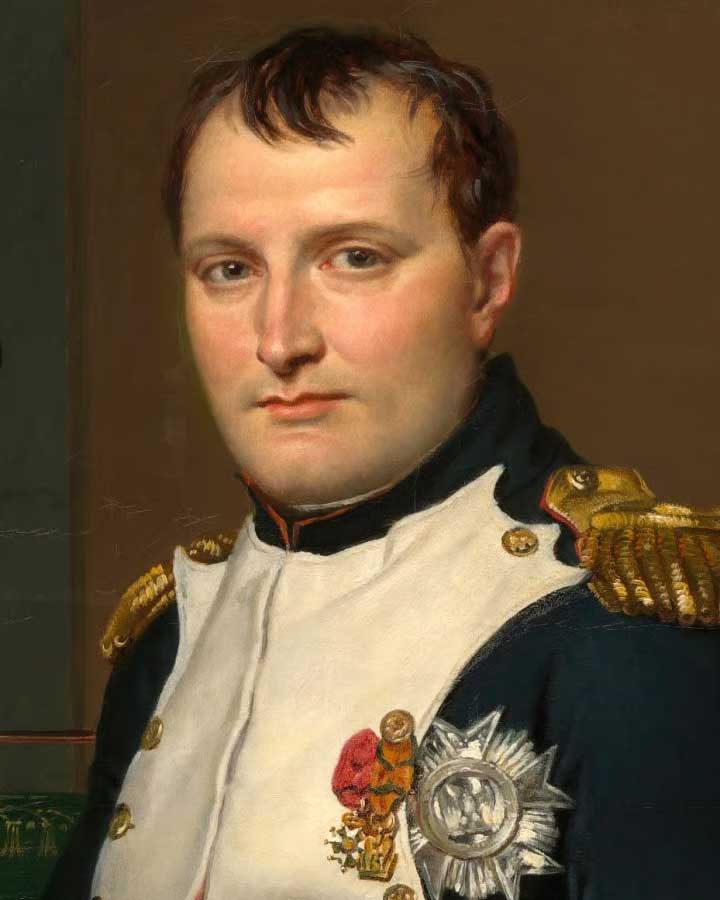
1769-1821
Public figure profile
Napoleon Bonaparte
French emperor and military commander
High openness, high discipline, and low agreeableness: a profile built for vision, control, and conflict.
Versioned reconstruction: built from public sources and limited human calibration. Expert corrections and stronger evidence can update future versions.
Big Five profile
Openness To Experience
Openness to Experience describes a dimension of cognitive style that distinguishes imaginative, creative people from down-to-earth, conventional people.

Another characteristic of the open cognitive style is a facility for thinking in symbols and abstractions far removed from concrete experience. Depending on the individual's specific intellectual abilities, this symbolic cognition may take the form of mathematical, logical, or geometric thinking, artistic and metaphorical use of language, music composition or performance, or one of the many visual or performing arts.
People with low scores on openness to experience tend to have narrow, common interests. They prefer the plain, straightforward, and obvious over the complex, ambiguous, and subtle. They may regard the arts and sciences with suspicion, regarding these endeavors as abstruse or of no practical use. Closed people prefer familiarity over novelty; they are conservative and resistant to change.
Openness is often presented as healthier or more mature by psychologists, who are often themselves open to experience. However, open and closed styles of thinking are useful in different environments. The intellectual style of the open person may serve a professor well, but research has shown that closed thinking is related to superior job performance in police work, sales, and a number of service occupations.
Conscientiousness
Conscientiousness concerns the way in which we control, regulate, and direct our impulses.

Impulsive behavior, even when not seriously destructive, diminishes a person's effectiveness in significant ways. Acting impulsively disallows contemplating alternative courses of action, some of which would have been wiser than the impulsive choice. Impulsivity also sidetracks people during projects that require organized sequences of steps or stages. Accomplishments of an impulsive person are therefore small, scattered, and inconsistent.
A hallmark of intelligence, what potentially separates human beings from earlier life forms, is the ability to think about future consequences before acting on an impulse. Intelligent activity involves contemplation of long-range goals, organizing and planning routes to these goals, and persisting toward one's goals in the face of short-lived impulses to the contrary. The idea that intelligence involves impulse control is nicely captured by the term prudence, an alternative label for the Conscientiousness domain. Prudent means both wise and cautious.
Persons who score high on the Conscientiousness scale are, in fact, perceived by others as intelligent. The benefits of high conscientiousness are obvious. Conscientious individuals avoid trouble and achieve high levels of success through purposeful planning and persistence. They are also positively regarded by others as intelligent and reliable. On the negative side, they can be compulsive perfectionists and workaholics. Furthermore, extremely conscientious individuals might be regarded as stuffy and boring.
Unconscientious people may be criticized for their unreliability, lack of ambition, and failure to stay within the lines, but they will experience many short-lived pleasures and they will never be called stuffy.
Extraversion
Extraversion is marked by pronounced engagement with the external world.

The independence and reserve of the introvert is sometimes mistaken as unfriendliness or arrogance. In reality, an introvert who scores high on the agreeableness dimension will not seek others out but will be quite pleasant when approached.
Agreeableness
Agreeableness reflects individual differences in concern with cooperation and social harmony.

Agreeableness is obviously advantageous for attaining and maintaining popularity. Agreeable people are better liked than disagreeable people. On the other hand, agreeableness is not useful in situations that require tough or absolute objective decisions. Disagreeable people can make excellent scientists, critics, or soldiers.
Neuroticism
Neuroticism refers to the tendency to experience negative feelings.

People high in neuroticism are emotionally reactive. They respond emotionally to events that would not affect most people, and their reactions tend to be more intense than normal. They are more likely to interpret ordinary situations as threatening, and minor frustrations as hopelessly difficult.
Their negative emotional reactions tend to persist for unusually long periods of time, which means they are often in a bad mood. These problems in emotional regulation can diminish a neurotic's ability to think clearly, make decisions, and cope effectively with stress.
B5+ interpretation
Strengths
- Easily juggles several tasks at once.
- Comfortably voices opinions and leads.
- Attracted to fast-moving, high-stimulus work.
Weaknesses
- Tendency to be argumentative and oppositional can create conflict.
- Can be overly diplomatic to the point of being unclear or deceptive.
Stress Response Profile
This metric describes personality tendencies related to how the person may respond to pressure. It covers Reactivity, Resilience, and Self-regulation. It does not establish the person’s current stress level or observed behavior in a particular event.
Bounce Back
Bounce Back estimates a personality pattern associated with emotional stability after pressure. It does not measure an actual setback or recovery time.
Communication Style
This metric summarizes the person’s likely communication tendencies across four core dimensions:
- Confidence: How likely the person is to express ideas and state a position confidently and directly.
- Adaptability: How likely the person is to adjust their communication style across audiences and situations.
- Receptiveness: How likely the person is to consider other people’s views before responding.
- Emotional Tone: The emotional tone of the communication style.
Honesty Blind Spots
Not elevated
Not elevated
Only unusually high patterns receive a score here.
This metric shows two indirect personality proxies related to selective disclosure and self-serving presentation. It does not establish deception:
- Omission: A cautious and socially reserved pattern that may relate to selective disclosure.
- Fabrication: Lower straightforwardness combined with lower modesty, which may relate to self-serving presentation.
Curiosity
This metric estimates the personality pattern’s orientation toward complex ideas, learning, imagination, and new experiences.
Online Persona
How much other people's reactions may shape public self-presentation.
Sharing Style
Scores show how the profile compares with other people. Around 50 is typical.
This metric looks at two parts of likely online self-presentation:
- Audience Sensitivity: How strongly the profile may register and respond to other people's reactions.
- Sharing Style: Whether the sharing style is more spontaneous or more carefully shaped.
Attachment Pattern Index (API)
Attachment pattern summarizes anxiety and avoidance signals around reliance, loyalty, and interpersonal distance.
Autonomy Index
Autonomy index estimates whether the profile leans more self-directed or more group-oriented in action and affiliation.
Creativity Profile
Creativity profile separates expressive imagination from problem-solving novelty.
Persuasion Vulnerability
Typical susceptibility
Persuasion vulnerability estimates which influence patterns would be easier or harder for the profile to resist.
Procrastination Drag
Higher scores indicate more personality-linked friction with task initiation and follow-through.
This metric estimates a personality-linked tendency toward task delay and follow-through friction. It does not observe how often the person procrastinated in a specific setting.
Risk Spectrum
Left = stronger caution and restraint; right = stronger novelty-seeking and willingness to act under uncertainty.
This metric estimates a personality-based balance between risk-seeking and caution. It does not predict a specific decision:
- Exploration: A pull toward excitement, new experiences, and acting on opportunities.
- Caution: A pull toward deliberation, restraint, and avoiding rash action.
Leadership Tendencies
This metric summarizes three personality tendencies that may shape how the person approaches leadership-related situations. It does not establish leadership skill or effectiveness:
- Exploratory Thinking: A tendency to engage with complex ideas, consider possibilities, and explore new approaches.
- People Engagement: A tendency to take an active social role, communicate directly, and engage with others.
- Follow-through: A tendency toward organization, persistence, and completing planned work.
Financial Discipline
This metric estimates personality-linked tendencies around financial self-regulation and three possible spending motives: novelty, prestige, and emotional comfort. It does not describe actual purchases, income, debt, or budgeting behavior.
Idea–Execution Balance
This metric separates Idea Orientation from Execution Orientation and shows the relative balance between them. A centered balance means the two orientation scores are similar relative to the reference group; it does not mean either score is average.
Negotiation Style
Largest share: Competing
This metric estimates the person’s relative mix of five conflict-response tendencies from personality facets. The five shares add to 100 within the profile; they are not results from the Thomas-Kilmann instrument:
- Competing: Giving greater priority to one’s own position and goals when interests conflict.
- Accommodating: Giving greater priority to the other person’s concerns and the relationship.
- Avoiding: Stepping back, delaying, or limiting engagement with the conflict.
- Collaborating: Working through both sides’ concerns to seek a solution that addresses both.
- Compromising: Seeking a middle ground where each side accepts part of what it wants.
Venture Profile Index (VPI)
The Venture Profile Index compares this personality pattern with a theory-guided venture-oriented profile. It does not establish entrepreneurial ability, readiness, or likely success. Six pillars are shown, though Risk Calibration is excluded from the aggregate:
- Opportunity Scanning: A tendency toward intellectual exploration, imagination, and openness to new possibilities.
- Execution Drive: A tendency toward organization, persistence, and goal-directed follow-through.
- Social Capital: A tendency toward social energy, assertiveness, and engagement with other people.
- Adaptive Resilience: A tendency toward emotional steadiness and confidence when demands rise.
- Co-op Credibility: A tendency toward cooperation, consideration, and trust when working with others.
- Risk Calibration: A tendency to combine novelty-seeking with caution and restraint.
Role Style Alignment
This metric compares the personality pattern with personality-related work-style requirements across role families. It does not measure skills, experience, interests, qualifications, performance, or likely success.
Most natural
Research Scientist
Least natural
Psychology / Counseling
These roles scored close together, so treat the order as a rough guide.
Other roles
- Data Analyst
- Marketing Professional
- Sales / Biz-Dev
- Product Manager
- Entrepreneur / Founder
- Skilled Trades
- Financial Analyst
- Project Manager
- Medical Practitioner
- Legal Counsel
- Creative / Design
- Software Engineering
- UX Researcher
- Protective Services
- Teacher
- Artist / Writer
- HR Specialist
- Social Impact Worker
- Customer Service
- Administrative Pro
Conflict Response
After conflict, an emotional impact may remain while the profile also leans toward repairing the relationship. Each score compares that tendency with other people. Around 50 is typical.
- Emotional Impact:How strongly tension or hurt may remain after a disagreement.
- Repair Orientation:How strongly the profile leans toward rebuilding trust, seeking understanding, and moving forward.
Both can be strong at once. A disagreement may leave a deep emotional mark while the profile still leans toward repair.
Chaos & Order
This metric compares spontaneity and impulse with structure and deliberation. A centered result means the two sides are balanced within the profile, not that either side is average.
Tyrant Potential
Strong elevation
A score appears only when forcefulness and hostile reactions rise together beyond the usual range.
Tyrant potential summarizes dominance, low restraint, and low empathy signals as a leadership-risk style, not a clinical label.
Grit Quotient
Grit quotient estimates persistence under long effort and resistance to giving up.
Schadenfreude
Elevated
Schadenfreude gauge estimates the pull toward competitive satisfaction when rivals lose ground.
Dogmatism
Not elevated
Tribal dogma estimates how strongly identity, loyalty, and in-group pressure may override independent revision.
Bullshit Radar
Lower
Scores show how the profile compares with other people. Around 50 is typical.
This metric estimates a personality-based analytic-reflection pattern from intellectual engagement and deliberative restraint. It does not test factual discernment or lie detection.
Conspiracy Vulnerability
Typical tendency
This index estimates susceptibility to hidden-plot explanations. Higher scores indicate a stronger tendency to distrust official narratives and connect events into a larger story; lower scores indicate a more conventional, evidence-led pattern.
Dark-Side Index
Strong elevation overall
Scores show how far each pattern rises above the ordinary range.
This metric estimates three non-clinical personality patterns and reports only unusual upper-tail elevations:
- Narcissism: Elevated self-focus, assertiveness, and desire for recognition.
- Machiavellianism: Elevated strategic social calculation, low interpersonal trust, and goal-focused control.
- Psychopathy: Elevated impulsivity, antagonism, and reduced concern for others.
Light-Side Index
Typical
Around 50 is typical.
This metric summarizes three Big Five-derived prosocial and self-regulation patterns. It reports only unusual upper-tail strengths:
- Integrity: Straightforwardness, concern for others, and willingness to trust.
- Humility: Modesty and consideration for other people’s feelings.
- Self-Control: Self-discipline and restraint of immediate impulses.
This speculative index estimates the profile's resilience in a hypothetical extreme-crisis scenario. It combines practical planning (Orderliness), emotional stability (Composure), and an adaptive mindset (Self-Efficacy & Adventurousness). A high score suggests a profile more suited for self-reliance in a crisis, while a low score suggests greater reliance on stable modern comforts.
Energy & Enthusiasm
Energy & Enthusiasm estimates the usual level of liveliness and visible enthusiasm in the reconstructed pattern. It does not infer physical stamina, health, or temporary mood.
Sociability
Sociability estimates how strongly the profile tends to seek conversation, company, and group activity. It does not measure popularity, confidence, or social skill.
Enjoyment of Thinking
Enjoyment of Thinking estimates the pull toward exploring ideas, comparing explanations, and engaging with difficult questions. It does not measure intelligence, education, knowledge, or correctness.
Standards & Pressure
Personal Standards
Inner Pressure
Standards & Pressure separates careful follow-through from pressure linked with uncertainty, mistakes, deadlines, or evaluation. The two signals are shown separately; there is no combined score.
Test yourself now. Compare later.
Take the free test now. Comparing your result with public figures is planned as a future feature.
Scientific methodology
View methodology and confidence levels for all 30 facets
150+Research references12Source clusters30/30Facets scored15/30Evidence-card eligible
Scientific methodology
View methodology and confidence levels for all 30 facets
How scores were built
The frozen figure fixture stores one conservative 1-5 mean for each of the 30 Big Five facets. Each Big Five domain is then displayed from its six facet means.
The B5+ modules read the same 30 stored facet means. The public methodology does not disclose proprietary weighting rules behind the advanced B5+ signals.
This version adds a single human proxy item-level calibration pass on top of the rater-reviewed fixture. The rater answered selected 120-item questionnaire statements on the normal 1-5 accuracy scale; reverse-scored items were converted after answer capture. The resulting facet means replaced only selected high-leverage inputs.
This displayed version is v3.1. If stronger sources, additional human ratings, or correction requests change the evidence picture, the profile should move to a new version rather than silently rewriting the old one.
How source confidence was handled
Confidence is an evidence-strength label, not a statistical confidence interval. It reflects source quality, independence, life-phase spread, directness, and whether meaningful counterevidence was found.
Low-confidence or contested facets remain in the model for completeness, but they are marked clearly and are not promoted as headline evidence cards.
All 30 facet confidence levels
| Facet | Score | Source confidence | Status | Conservatism | Public evidence |
|---|---|---|---|---|---|
| Openness To Experience | |||||
| Imagination | 4.25 | 80% | Ready | Mild | Eligible |
| Artistic Interests | 4.00 | 78% | Ready | Moderate | Eligible |
| Emotionality | 3.75 | 75% | Ready, contextual | Moderate | Eligible |
| Adventurousness | 3.50 | 78% | Ready, contested | Mild | Eligible |
| Intellect | 4.25 | 86% | Ready | Mild | Eligible |
| Liberalism | 3.00 | 70% | Ready, contested | Moderate | Do not feature |
| Conscientiousness | |||||
| Self-Efficacy | 4.25 | 88% | Ready | Mild | Eligible |
| Orderliness | 4.00 | 82% | Ready | Mild | Eligible |
| Dutifulness | 3.00 | 60% | Ready, contested | Moderate | Do not feature |
| Achievement-Striving | 4.25 | 91% | Ready | Mild | Eligible |
| Self-Discipline | 4.00 | 84% | Ready | Mild | Eligible |
| Cautiousness | 2.50 | 70% | Ready, contested | Moderate | Do not feature |
| Extraversion | |||||
| Friendliness | 3.00 | 58% | Mixed / low confidence | Moderate | Do not feature |
| Gregariousness | 2.75 | 66% | Ready, contested | Mild | Eligible |
| Assertiveness | 4.25 | 91% | Ready | Mild | Eligible |
| Activity Level | 4.50 | 90% | Ready | Mild | Eligible |
| Excitement-Seeking | 4.00 | 74% | Ready, contested | Mild | Eligible |
| Cheerfulness | 3.00 | 42% | Low confidence | Heavy | Do not feature |
| Agreeableness | |||||
| Trust | 3.00 | 72% | Ready, contextual | Moderate | Do not feature |
| Morality | 3.00 | 76% | Ready, contested | Moderate | Do not feature |
| Altruism | 3.25 | 52% | Mixed / low confidence | Moderate | Do not feature |
| Cooperation | 2.50 | 74% | Ready, contested | Moderate | Do not feature |
| Modesty | 2.00 | 82% | Moderate | Do not feature | |
| Sympathy | 2.75 | 66% | Ready, contested | Moderate | Do not feature |
| Neuroticism | |||||
| Anxiety | 3.25 | 64% | Ready, contested | Moderate | Eligible |
| Anger | 3.75 | 76% | Ready, contested | Moderate | Do not feature |
| Depression | 3.00 | 33% | Low confidence | Heavy | Do not feature |
| Self-Consciousness | 3.00 | 42% | Low confidence, contested | Heavy | Do not feature |
| Immoderation | 2.75 | 72% | Ready | Mild | Eligible |
| Vulnerability | 2.50 | 68% | Ready, contested | Moderate | Do not feature |
Limits
This is a historical reconstruction, not a clinical diagnosis and not a claim that Napoleon Bonaparte completed a test.
Fame, success, failure, public controversy, and moral reputation are not treated as trait evidence by themselves. Only documented behavior around those outcomes is used.
Late-life self-fashioning, official propaganda, memoir loyalty, and hostile-witness bias are discounted rather than accepted at face value.